Navodaya Cancer Hospital - Cure for Cancer NABH Accredited Ayushman Bharat NCDR
Breast Cancer

What is Breast Cancer?

The Most Common Cancer in Women.
One of the Most Treatable When Found Early.

More than 2.3 million women are diagnosed with breast cancer each year worldwide. In India, it is the most common cancer among women, with over 190,000 new cases diagnosed annually. Early detection, timely diagnosis, and personalized treatment can significantly improve outcomes.

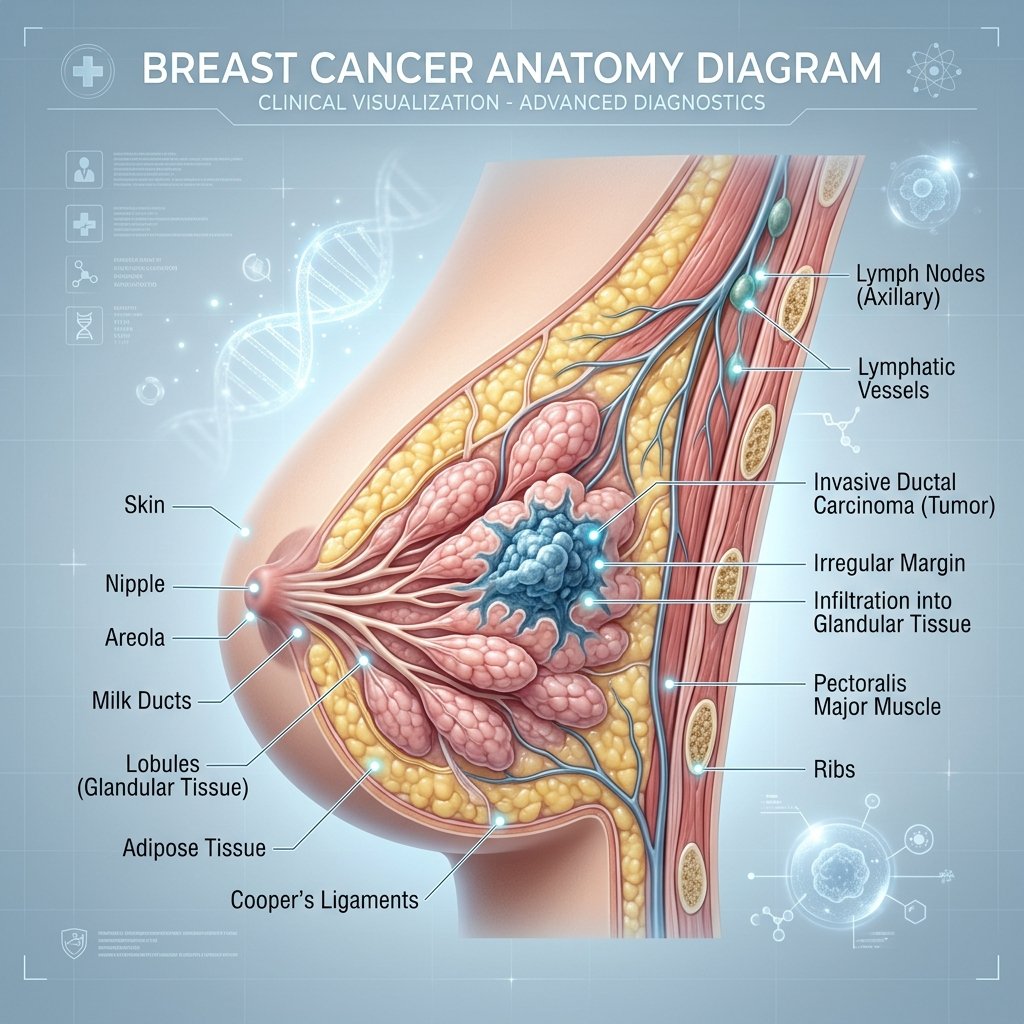
Breast cancer occurs when abnormal cells in the breast grow uncontrollably, forming a tumor. It most commonly begins in the milk ducts or lobules and, if left untreated, can spread to nearby lymph nodes and other parts of the body. Although it primarily affects women, breast cancer can also occur in men.

Signs & Symptoms

Consult your doctor if you notice:

  • A lump in the breast or armpit
  • Change in the size or shape of the breast
  • Nipple inversion or unusual discharge
  • Skin dimpling or thickening ("orange peel")
  • Redness or swelling of the breast
  • Persistent breast pain or discomfort
  • Enlarged lymph nodes

Not every breast lump is cancer, but every new lump should be evaluated by a specialist.

Risk Factors

Non-Modifiable
  • Increasing age & Female gender
  • Family history of breast or ovarian cancer
  • BRCA1/BRCA2 and other inherited gene mutations
  • Previous history of breast cancer
  • Early menstruation or late menopause
Lifestyle
  • Obesity & Physical inactivity
  • Smoking and alcohol consumption
  • Long-term hormone replacement therapy
  • Late first pregnancy or not breastfeeding

Screening & Early Detection

Regular screening can detect breast cancer before symptoms appear. Recommended methods include:

  • Breast Self-Awareness: Know what is normal for your breasts and report any changes promptly.
  • Clinical Breast Examination: Performed by a trained healthcare professional.
  • Mammography: The gold standard screening test for women at average risk.
  • Breast Ultrasound: Helpful in younger women and those with dense breast tissue.
  • Breast MRI: Recommended for selected women at high risk.

Diagnosis

If breast cancer is suspected, we utilize Mammography, Ultrasound, MRI, Core Needle Biopsy, and advanced imaging (PET-CT) for accurate staging.

Biomarker & Genetic Tests

Biomarker Tests

We test for ER, PR, HER2, and Ki-67 to determine the exact subtype and guide personalized treatment decisions.

Genetic Testing

Evaluates genes like BRCA1, BRCA2, PALB2, and TP53 to identify hereditary risks.

Treatment Options

Treatment is individualized based on stage and type. Our Multidisciplinary Tumor Board develops a personalized plan:
  • Surgery: To remove the tumor while preserving healthy tissue.
  • Chemotherapy: To destroy cancer cells before/after surgery.
  • Radiation Therapy: Using advanced techniques (IMRT, IGRT, VMAT, SBRT).
  • Hormone Therapy: For hormone receptor-positive cancers.
  • Targeted Therapy & Immunotherapy: For specific molecular characteristics (e.g. HER2).
Male Breast Cancer
Male Breast Cancer

A rare cancer that forms in the breast tissue of men. While breast cancer is most commonly thought of as a disease affecting women, it can occur in men at any age.


Early Signs & Symptoms:

  • A painless lump or thickening in breast tissue
  • Changes to the skin covering the breast
  • Changes to the nipple (redness or scaling)
  • Nipple discharge